Tiers of Christian Fellowship
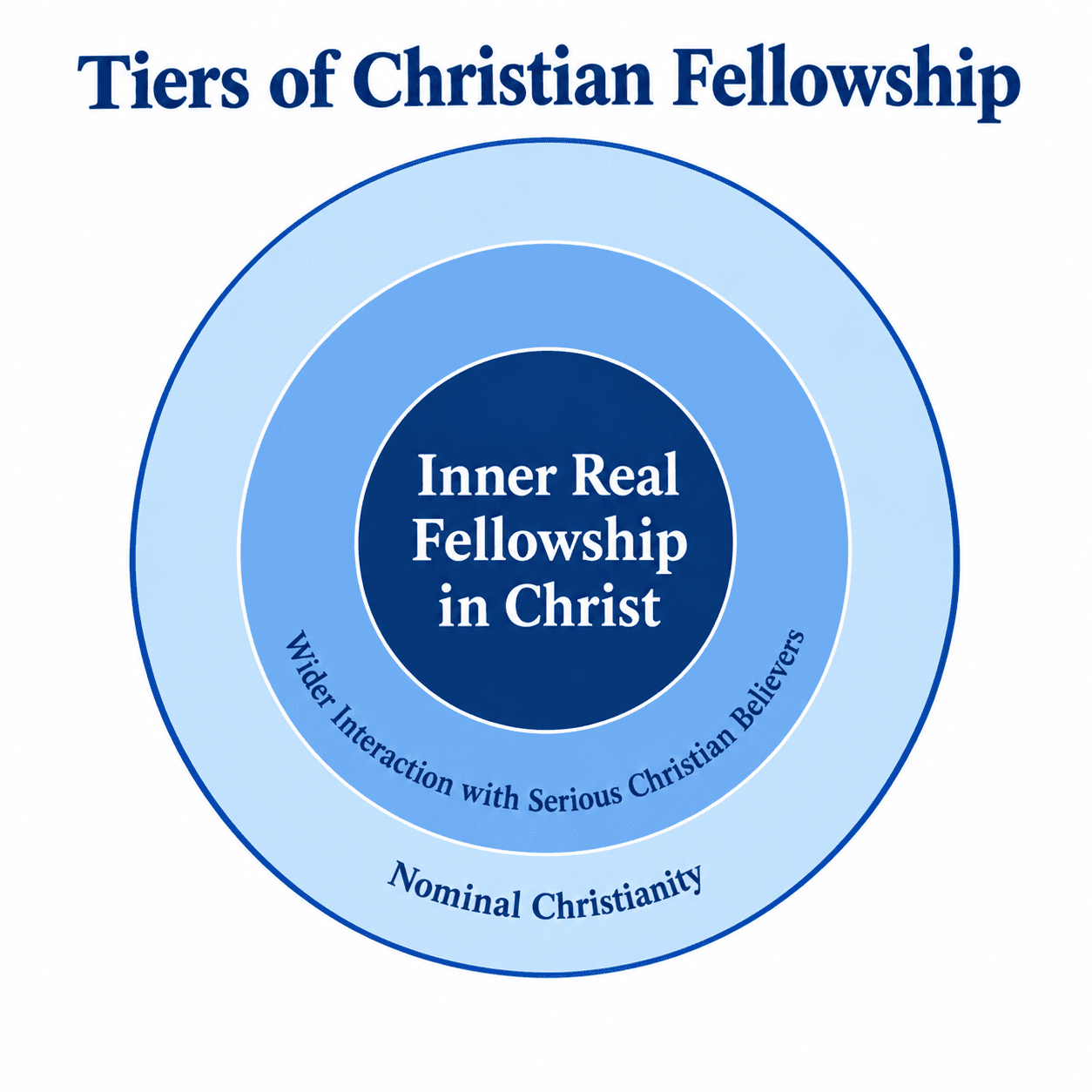
The church of Jesus began at Pentecost when “those who accepted his message, were baptized, and . . . they devoted themselves to the apostles' teaching and to koinonía (inner real fellowship in Christ), to the breaking of bread and to prayer.”1
The moment koinonía—real heart-felt fellowship in Christ—began, the church itself began. Through the Spirit of Christ, brothers and sisters found themselves together, caring one for another, deeply, to the point of dying one for another, as needed.
From their beginnings, Christian koinonía (fellowship) and the Christian ecclesia (the church) have sprung from the same source. Where one begins, the other one follows. Without koinonía there has never been a church at all—nothing but an empty shell.
So, with that established, where do you find yourself today? In both Christian fellowship and the Christian church interacting beautifully one with another in peace? Or in a mere nicely done building, with a bunch of people milling about, one with another, saying “Hi” one to another every Sunday morning?
Do not let anyone fool you!
Human organisations, particularly ecclesiastical ones—commonly known as “churches”—do not automatically include real fellowship—real koinonía as the early Christians called it. In fact, more often than not, you may have a hard time finding it anywhere. For sure in well established widely-known “churches.”
What, in fact, should one look for in searching for fellowship—the koinonía—of Christ?
Because of the human condition itself, one needs to learn how to differentiate Christian interaction—beginning with . . .
The First Tier of Christian Fellowship
Where earnest seekers finally meet one another in Christ, fellowship naturally flows throughout and within them. On a common search for a common cause, sharing their same values, humble seekers discover the joy of one another’s presence. The more they get together, the more they like it, and whether they identify it as such or not, they have found the first and by far the most important tier of fellowship in Christ.
No matter how small, informal or spontaneous to begin with, this first tier of Christian fellowship revolves around loving one another as much as one loves oneself—or even more. Not only through good times, but also through problems, fears, hopes, sudden surprises, needed adjustments, and finally through sharing a common destiny in the LORD.
With thankful hearts, through loving and trusting one another, followers of Christ gladly share what they have and need—not through compulsion, not through any humanly organised structure, but through what they have found in Him. Loving one another as earnestly and fervently as they love themselves.
Once this degree of fellowship has reached its fulfilment amongst believers—no matter where they live, what language they speak, or how they look or dress—this first tier of fellowship stands secure. A treasure to hold onto as long as one lives, but there is also . . .
A Second Tier of Christian Fellowship
Much larger than the first, this second tier of Christian fellowship involves all earnest believers whom one has known and respects through the years. Fellow Christians, friends in the LORD, one knows them, yet not as frequently and not as intimately as those of the first tier.
One meets these Christian friends all the time, maintaining polite yet casual relationships, through which one has less in common regarding values, interests, convictions and goals. People, who one has no reason to distrust or condemn, yet with whom one does not feel inclined to follow.
Whether meeting together in regular worship services or not― How should one relate to Christians of this second tier of fellowship?
It would be both foolish and wrong—even sinful—to judge all other believers simply because they do not interact closely within one’s first tier of fellowship. Humans naturally have a wider spread of casual friends and acquaintances, yet almost everyone, also has a few bosom friends with whom one shares everything. That is how it works in society and it works in the fellowship of Jesus Christ. Even within His twelve disciples Jesus recognised tiers of fellowship amongst those who followed Him, and the process will continue.
As long as we live on earth, we will interact with Christian believers who think, act and believe in ways that we would not choose for ourselves. Thankfully, not everyone does and says what we do. Diversity in Christ does not automatically spell division—yet “can two walk together unless they are agreed?”2
Personally, I have always gladly interacted with a vast number of serious Christian believers who do not share my values exactly, who do not work for the causes I have championed, nor gone the direction I have chosen to go. Yet, far from condemning or separating myself from them, I have learned amazingly much from them, and I remain extremely glad to leave their everlasting destiny within the capable hands of the LORD. Then there is also . . .
The Third Tier of Christian Fellowship
All around the world there are millions—possibly billions—of professors of Christ, with whom I have little contact and very little in common. I live in the “Christian nation” of Paraguay. My entire continent was “Christianised” centuries ago, and for that I have little more to say.
Their story tells itself.
Three Tiers of Fellowship Today
Paul wrote: “God, who has called you into koinonía with his Son Jesus Christ our Lord, is faithful. Therefore I appeal to you, brothers and sisters, in the name of our Lord Jesus Christ, that all of you agree with one another so that there may be no divisions amongst you and that you may be perfectly united in mind and thought.”3
Obviously Paul hoped that as many as possible would find “perfect unity in mind and thought” within the first tier of Christian fellowship. But did he restrict all interaction to that?
Not exactly, yet he warned his followers of the dangers involved in loose fellowships with others.
Paul and the rest of the early Christians interacted with all kinds of seeking souls, some of them still totally Jewish, some partially out of their transitional mindset, and many others from pagan backgrounds. Some of them were genuinely convinced, a few still in the balance, and others—unfortunately—insincere or even malicious. For this reason he also wrote:
Do not be yoked together with unbelievers. For what do righteousness and wickedness have in common? Or what fellowship can light have with darkness?
What harmony is there between Christ and Belial? What does a believer have in common with an unbeliever?
What agreement is there between the temple of God and idols? For we are the temple of the living God, as God has said: “I will live with them and walk amongst them, and I will be their God, and they will be my people.”4
“Therefore come out from them and be separate, says the LORD. Touch no unclean thing, and I will receive you.”5
“I will be a Father to you, and you will be my sons and daughters, says the LORD Almighty.”6
Within a few years of Christian experience, and certainly within the second or third generation after the ascension of Christ, one sect of his followers after the next appeared. How could one ever safely and correctly discern with whom and how, one should find fellowship in Him?
Thankfully, the answer has never been hard to find.
From the beginning of time, humans have observed that “birds of a feather, flock together.” If one only speaks of outward things—in other words how people are dressed—this saying is cheap and trite. But in the heart of the matter the truth indeed may be found.
Ravens have nothing in common with humming birds, crows never mate with hawks, and sparrows spend no time flying about with killdeers, owls, or chickens.
Neither do those who love the LORD and those who do not.
The answer is that simple—and that profound.
You and the fellowship you find, says everything about you—both about you and about them. Your actions, including your choice of companions, not only reveals your interest but also your direction, and in the end, your destiny.
“Perfect unity in mind and thought”, only happens amongst Christians who know Him—and who, in turn, are known by Him. Wherever unity wanes, disappears, or has not even existed, one may say and do what they wish, but no amount of make-believe or fake fellowship, will ever take its place.
Saying nice things one to another on Sunday morning, has never, in itself, created fellowship. Neither does wearing a uniform costume, professing a common set of beliefs, or having one’s name on anyone’s membership list. The only kind of relationship that endures, suffers, defends, supports one another, corrects, and keeps on rejoicing, as long as one lives, comes from the light and love of Christ himself—and that, praise the LORD, will last forever!
The closer one draws to Christ, through love, worship, and subjection to Him, the more intimate our koinonía—our real fellowship—grows one with another in Him.
Whatever the case, whether you fully understand it or not, don’t miss it!
This koinonía, is the only treasure you will ever take from this life into the next.
Scripture references
- Acts 2:41-42
- Amos 3:3
- 1 Corinthians 1:9-10
- 2 Corinthians 6:14-16, (Leviticus 26:12, Jeremiah 32:38, Ezekiel 37:27)
- Isaiah 52:11, Ezekiel 20:34,41
- 2 Samuel 7:14, 7:8